
Ferret 101
Everything you didn't know you wanted to know about the world's most chaotic little carnivore.
What Is a Ferret?
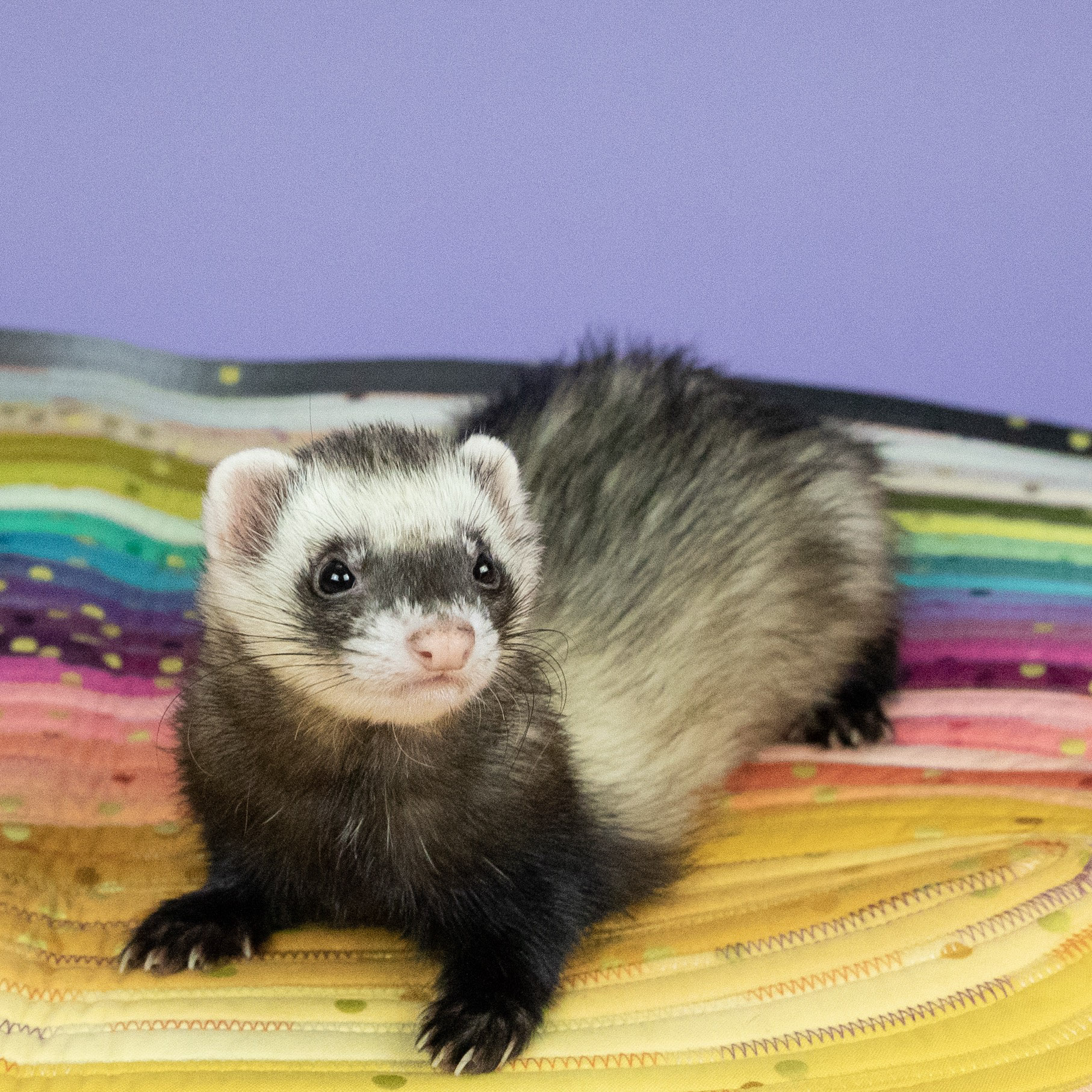
Ferrets (Mustela putorius furo) are domesticated descendants of the European polecat. They have been domesticated for approximately 2,500 years, originally bred and trained for hunting rabbits and controlling rodent populations. Today ferrets are one of the most popular small companion animals in the United States, with an estimated population of several million owned pets.
Ferrets are obligate carnivores. Their entire digestive system is optimized for meat. They have no metabolic pathway for efficiently using carbohydrates as energy, they cannot synthesize certain amino acids and fatty acids that plant-eating animals can, and their digestive tract is short enough to process a meal in 3 to 4 hours. This is not a diet preference, it is biology. A ferret eating a grain-heavy diet is not eating poorly by choice; it is eating poorly because its owner has not understood what it actually is.
The Mustelid Family
Ferrets belong to the family Mustelidae, one of the most diverse carnivore families on earth. Mustelids share key traits: elongated bodies, short legs, high metabolic rates, and scent glands. They evolved as dedicated hunters across a wide range of habitats, from aquatic to subterranean to arboreal.
The domestic ferret's closest wild relative is the European polecat. The black-footed ferret of North America is a separate wild species, not a domestic ferret, and one of the most endangered mammals on the continent.
Physical Traits and Senses
Ferrets have poor distance vision but exceptional close-range vision and strong motion detection. Their hearing is acute, tuned toward higher-frequency sounds. Their sense of smell is their primary navigation tool, how they identify people, other ferrets, and food. Owners often notice their ferret sniffing them thoroughly after returning home from somewhere new.
The ferret spine is remarkably flexible. A ferret can compress its body to fit through any opening larger than its skull. This is not a parlor trick; it is how mustelids pursue prey into burrows and underground systems. It is also how your ferret will escape any enclosure you did not design with this specifically in mind.
Natural Behaviors
Every ferret behavior that surprises or alarms new owners has a biological explanation. Understanding the reason behind the behavior is the fastest path to understanding your ferret.
Dooking
A rapid, rhythmic clucking or chuckling sound ferrets make during excitement and play. Dooking is the sound of happiness. It evolved as a social contact call between mustelids engaging in cooperative or playful behavior.
Weasel War Dance
Arched back, sideways bouncing, open mouth, apparent loss of coordination. This is peak excitement, not aggression. The war dance evolved as an overstimulation response in mustelids during high-arousal hunting scenarios. In domestic ferrets, play and exploration trigger the same response.
Stashing and Caching
Ferrets drag food, toys, socks, and anything small into hidden corners, behind furniture, or under blankets. This is prey-caching behavior inherited from wild mustelids who would store surplus kills for later. Your ferret does not know the sock is not food.
Dead Sleep
Ferrets enter an unusually deep sleep where they become limp, unresponsive, and can appear genuinely dead. This alarms new owners consistently. It is completely normal. Ferrets sleep 14-18 hours per day and some portion of that is very deep sleep. Pick them up gently and they will wake within a moment or two.
Back-Into-Corner Elimination
Ferrets instinctively back into corners to eliminate. This is a retained wild behavior. In the open, mustelids back into dense vegetation or corner spaces to remain protected while vulnerable. Litter training works because you are exploiting this hardwired spatial instinct.
Common Misconceptions
Ferrets are misunderstood in ways that matter for their welfare. Here are the five most common misconceptions we hear, and why they are wrong.
"Ferrets smell terrible."
Diet and bathing frequency drive most of the odor. Raw-fed ferrets smell significantly less than kibble-fed ones. Bathing too frequently makes the problem worse, not better, because it triggers the musk glands to overproduce. A healthy, properly fed ferret has a mild, musky scent, not a smell that takes over a room.
"Ferrets are aggressive."
Biting in young ferrets is exploratory, not aggression. Ferret kits learn the world through their mouths the same way puppies do. It diminishes substantially with training and maturity. A ferret that bites as an adult typically has a history of inadequate socialization or fear from a bad experience, not an aggressive temperament.
"Ferrets are like cats or dogs."
They require exotic vet care, have specific dietary needs cats and dogs do not share, and have a much shorter and more disease-prone lifespan. General practice vets often lack meaningful ferret experience. Ferrets are not beginner pets in the way that dogs and cats can be.
"Ferrets are cheap and low-maintenance."
They are prone to serious and expensive diseases, including insulinoma, adrenal disease, and lymphoma, often by age 4-5. They require significant daily interaction to remain socialized and mentally healthy. Annual vet care costs are real even in healthy years, and disease management costs can reach several thousand dollars per year.
"All ferrets from pet stores are the same."
Marshall BioResources ferrets, which account for the majority of US pet store ferrets, are spayed and neutered at 5-6 weeks old. Early desexing significantly increases adrenal disease risk later in life. Ferrets from private breeders who neuter later (or use hormone implants instead of surgery) have measurably better long-term health outcomes.
Fun Facts
- A group of ferrets is called a business. The term appears in 15th-century English texts cataloguing proper collective nouns for animals, known as Books of St. Albans.
- Ferrets sleep 14-18 hours per day. Older ferrets can sleep up to 20-22 hours.
- Ferrets have been used to run cables through conduit on large infrastructure and event projects, including reportedly at some large venues and stadiums. Their slim, flexible bodies fit through conduit that standard equipment cannot navigate.
- Ferrets are one of the few animals that contract human influenza. This makes them a primary model organism for flu research, and ferret-derived data has directly informed human vaccine development.
- Domesticated ferrets have lost the instincts and skills required to survive in the wild. A domestic ferret released outdoors would not last long.
- European ferrets are generally healthier and longer-lived than US Marshall BioResources ferrets, largely because European breeding practices do not involve early desexing.
- The domestic ferret has been working alongside humans for approximately 2,500 years, originally bred and trained for hunting rabbits and rodent control.
- Ferrets are crepuscular by nature, most active at dawn and dusk, but they adapt their schedule to match their owner's activity patterns.
- Male ferrets (hobs) are roughly twice the size of females (jills). An intact hob during breeding season will also produce a noticeably stronger musk odor.
Stay current on ferret care.
Join our email list for tips on behavior, diet, health, and enrichment.
We also recommend bookmarking this site for quick reference.